The landing page
Your client logos, your five experiences, proof from past events and a short form. A second version is ready to test against it as visits add up.
 MCR AGENCY
Everything we talked about, built as one system: your own AI workspace, MCR Studio for every inquiry and every event, and a page that brand teams land on from Google, with your Google and Meta ads set up. Built for the two of you, in your brand, and yours to keep.
MCR Studio preview: mcr-portal.agentnest.co, then press Continue. It runs on example brands and numbers; yours will run on your own.
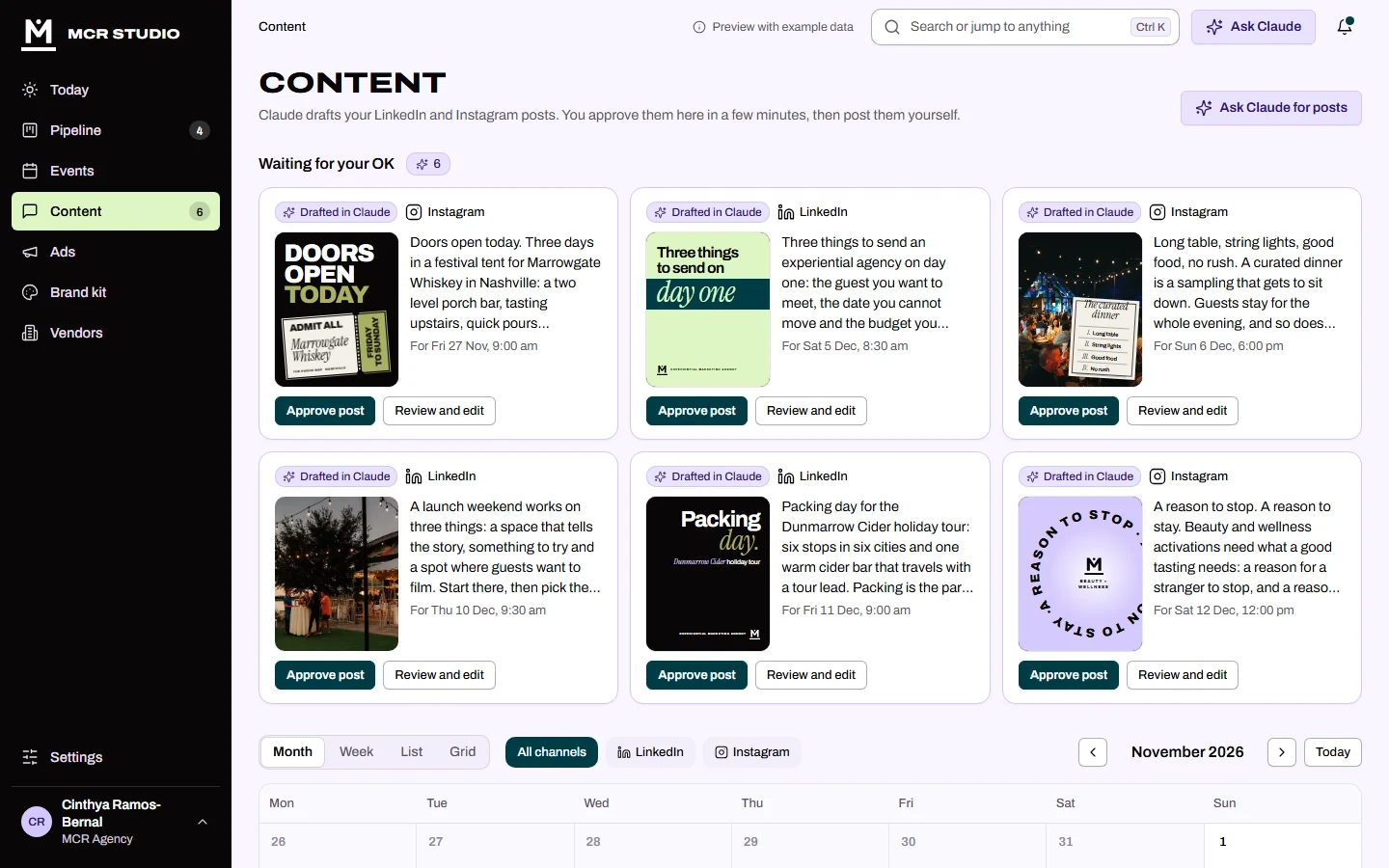
Claude does the work, MCR Studio shows it and keeps it, and the landing page brings in the brand teams who search for an agency like yours.
Claude on your MacBook, in your colors, fonts, logo and voice.
Concept decks, estimates by your four pillars, posts, articles, and your ads by chat (Google once it approves the connection).
Every brand inquiry in one pipeline, each event from brief to recap.
Posts to approve, your ads report, brand kit and vendors.
On the new site, made for the people who hire an experiential agency.
A second version to test, and every inquiry lands in your pipeline.
Included at no extra charge.
Google rebuilt as a Search campaign, a small Facebook and Instagram reminder campaign, and two weeks of check-ins.
Moments from your workflow, today and with the system. The quotes are your own words from our call.
Your ad shows on YouTube, Google Maps and other sites. A click lands on your home page, and nothing is counted.
“But there is no leads on that.” CinthyaA Search ad that matches what they typed, a page made for brand teams, and every inquiry counted in MCR Studio.
You find out where a client came from by asking them.
“We actually were able to get two clients from the website because we asked them…” CinthyaIt lands in your pipeline with where it came from and its next step. Referrals and trade-show contacts go in with three fields.
The visual and the estimate worked in parallel, from your past events and the ChatGPT setup you trained.
“So sometimes I’m trying to give the quote really quick.” CinthyaClaude drafts the concept deck and the estimate by create and direct, make, activate and deliver, from your past events. You put your mark on it and send.
Reviewing your writer’s posts, photos and wording, and still seeing mistakes when they go out.
“It takes me at least one day to review and update everything.” CinthyaClaude drafts the week in your voice, or checks your writer’s drafts, and the posts wait in MCR Studio for your OK.
Your social media content comes from the person you pay for it.
“The person that I’m paying for the social media content.” CinthyaDesigned carousels from your own brand kit and photos, filled in by Claude, ready to approve.
About $3.50 a day, no tracking, and no one looking after it.
“Nobody.” Rodrigo, on who runs itAsk Claude about the ads and it reads the numbers and suggests changes with the reason. Nothing changes until you approve it, never above your monthly budget. Google joins once it approves the connection.
Your ChatGPT agents change, and the training you put in goes with them.
“They are changing everything on December the 11th.” CinthyaYour own workspace on Claude is ready before that day, in your name and on your own plan.
Every screen below is in the preview and works in your browser, on a laptop or a phone. The brands, people and numbers in it are examples.
On a phone, tap a picture to open that screen, sized for your screen.
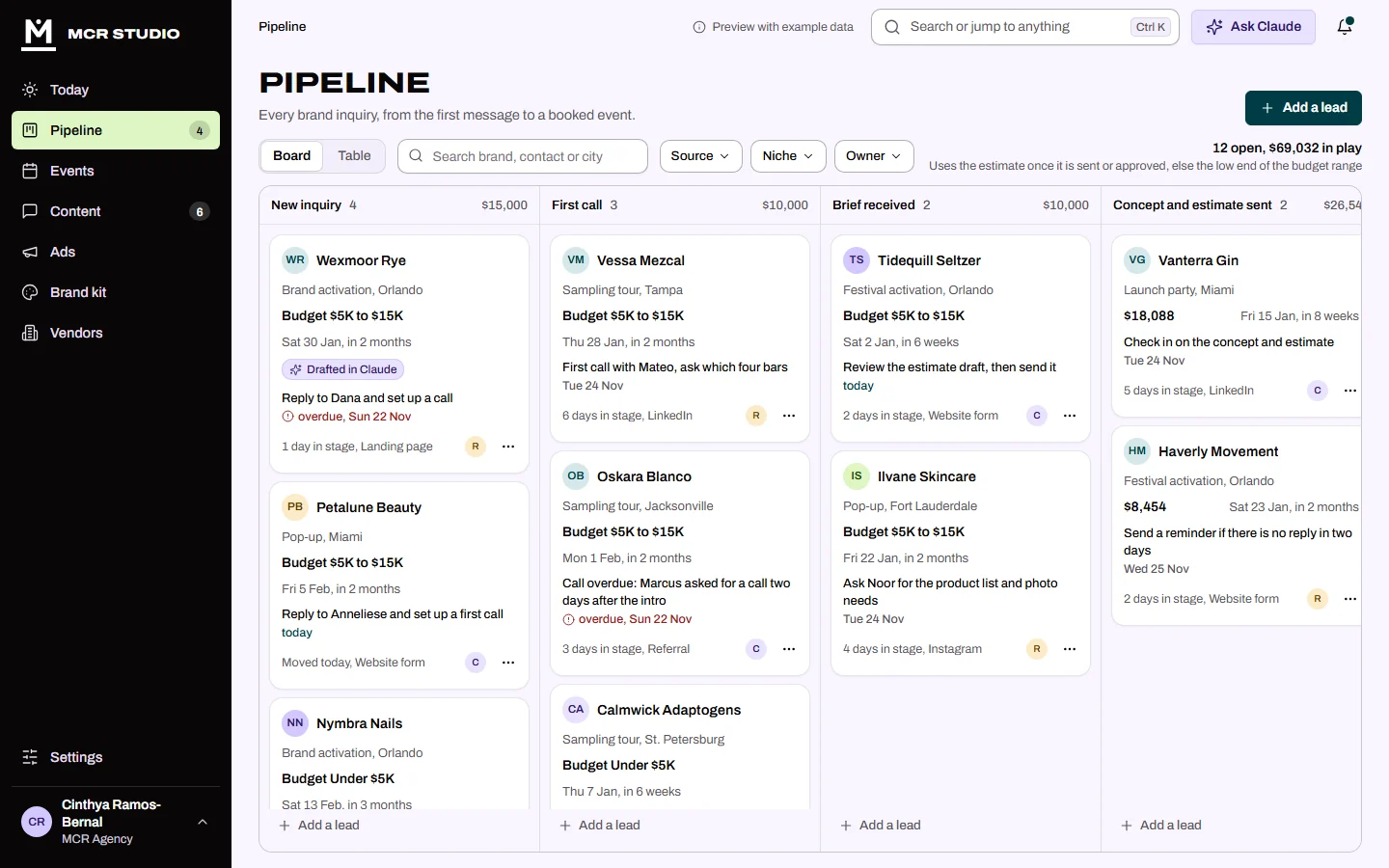
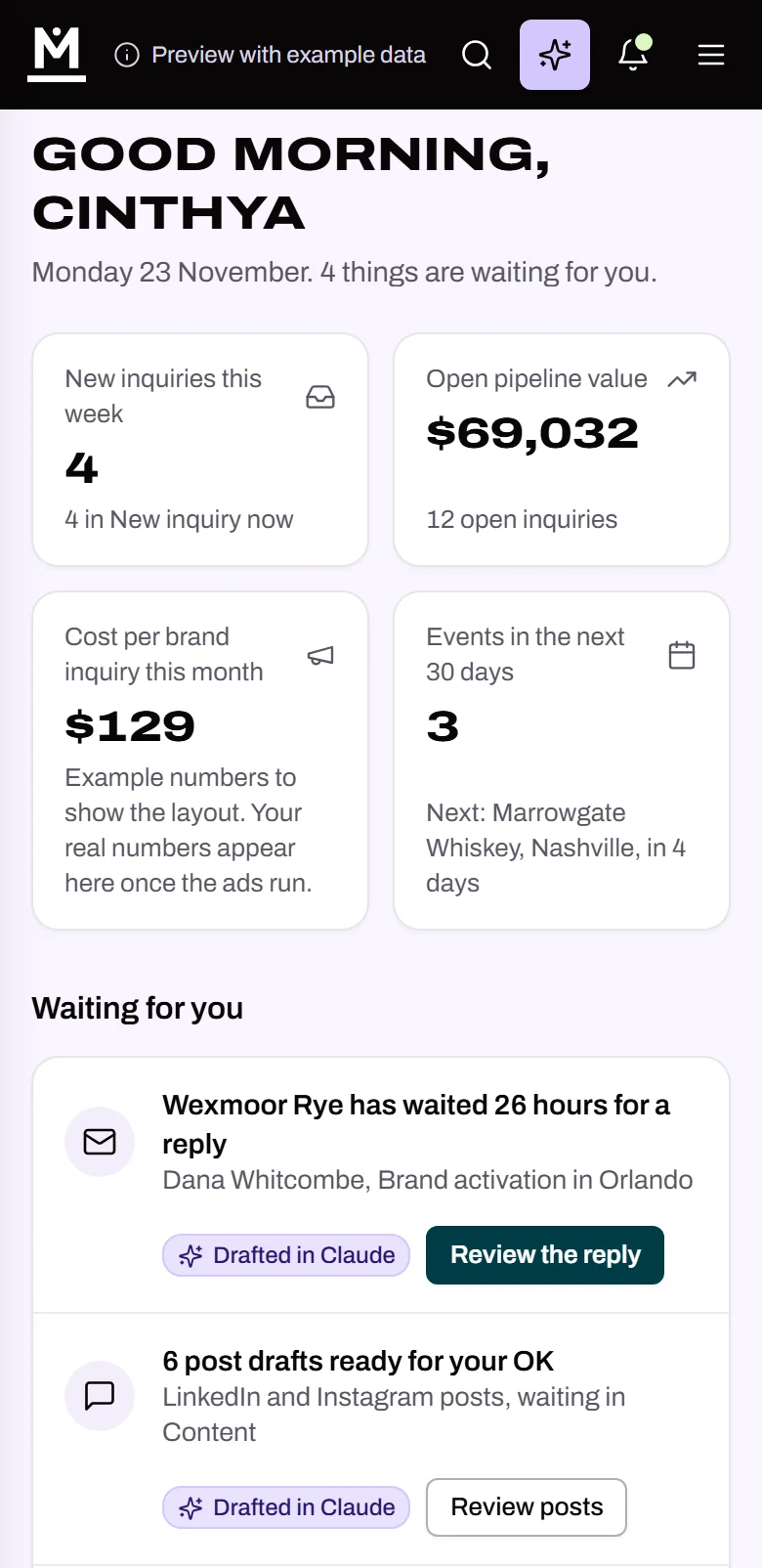
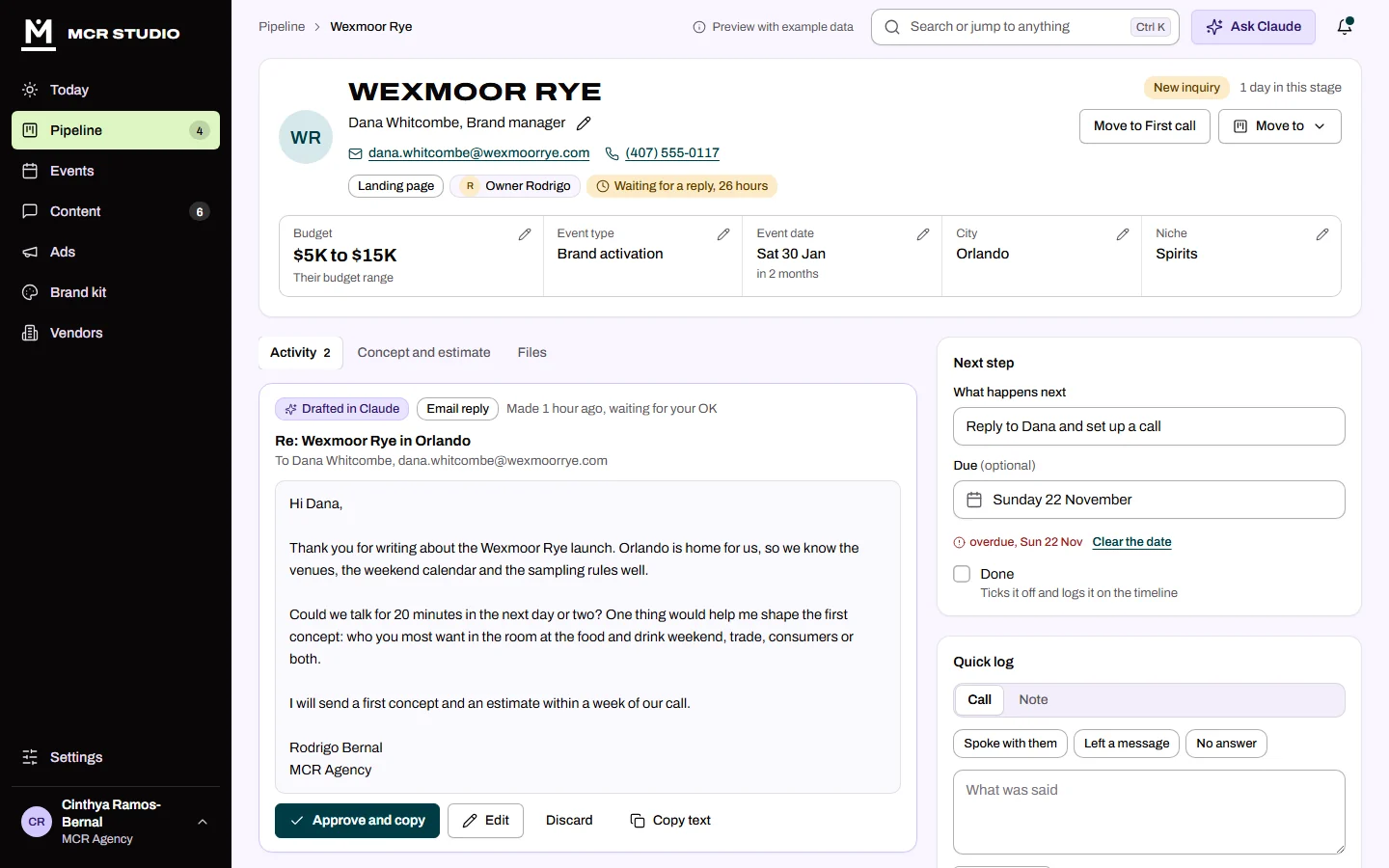
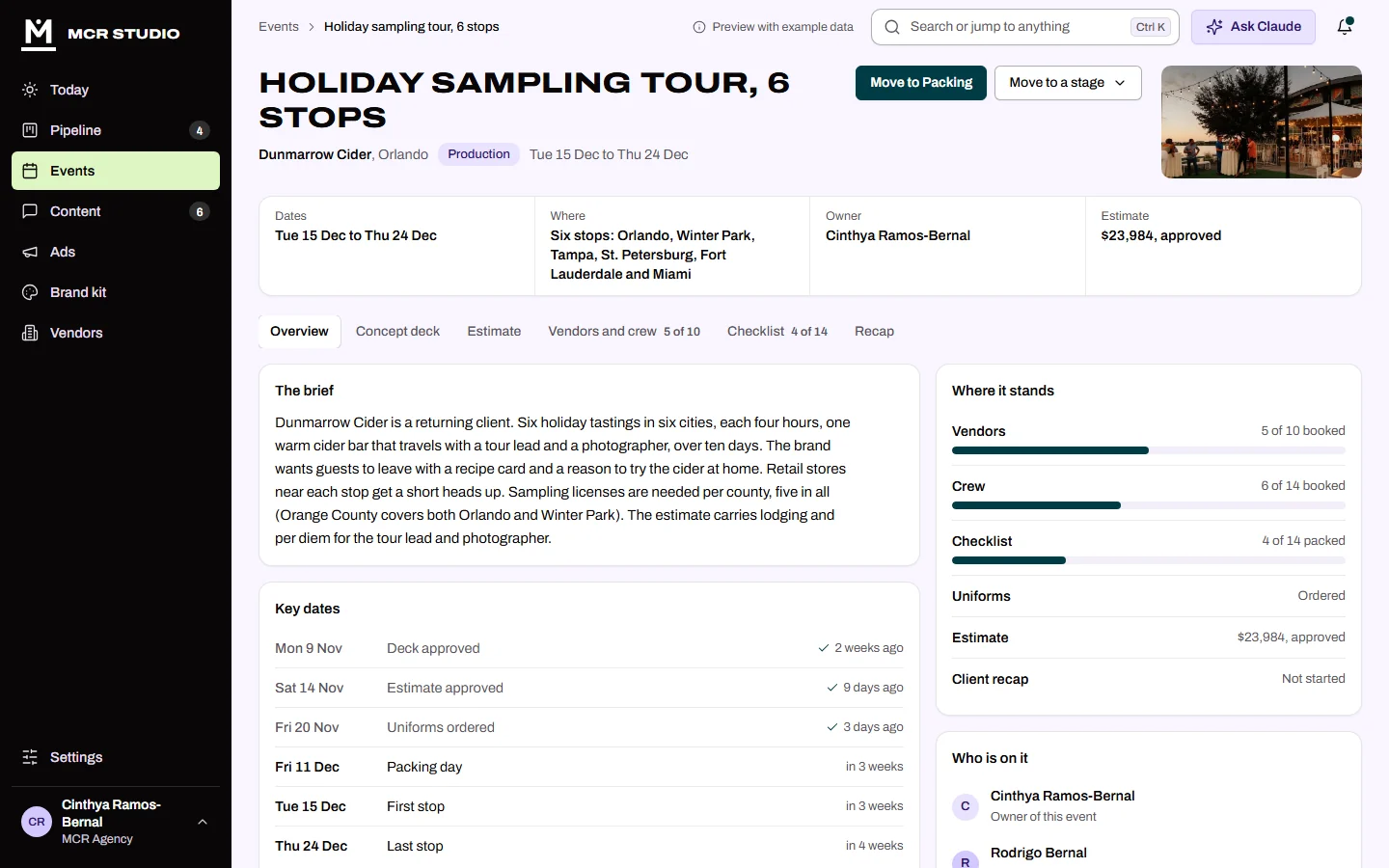
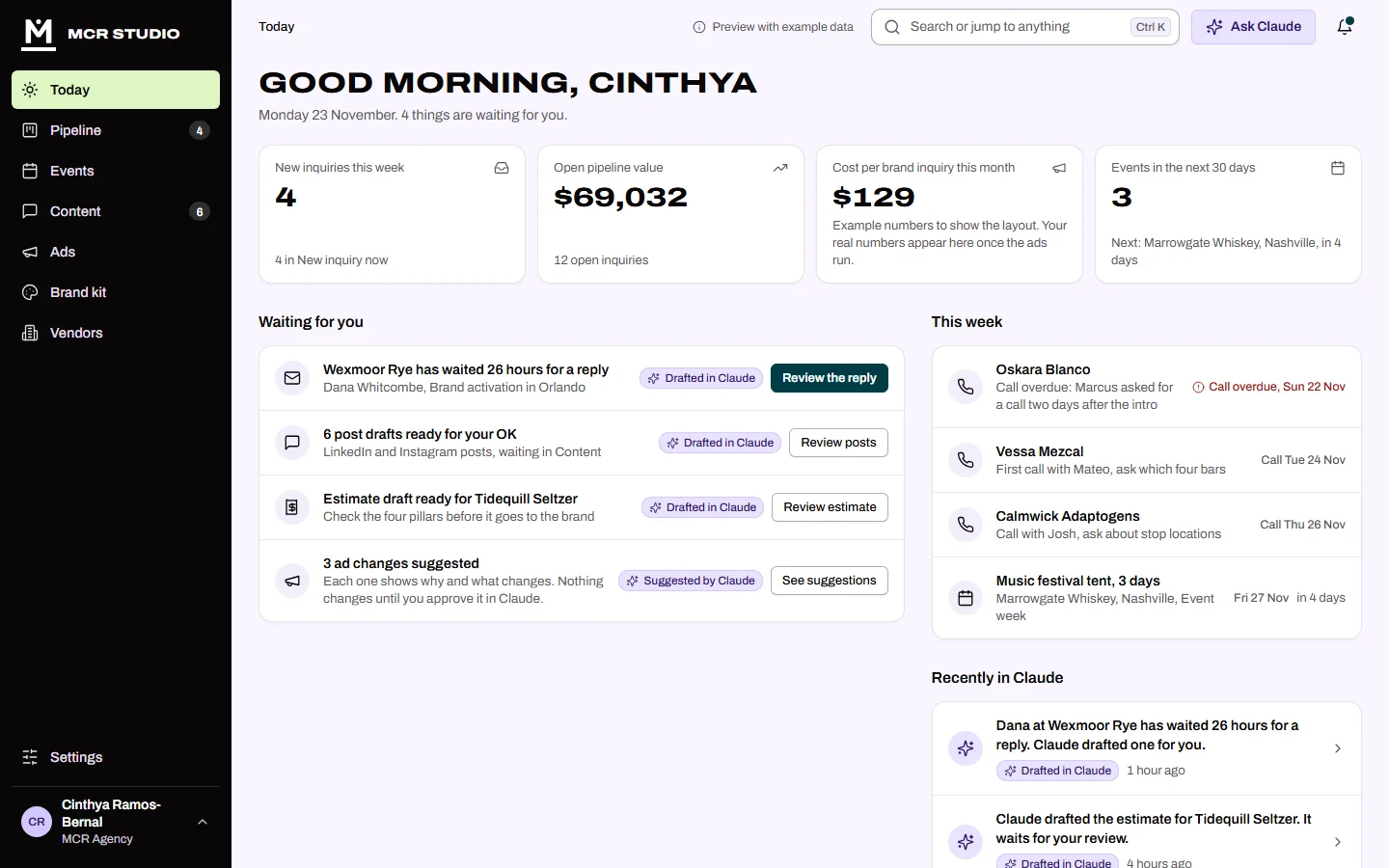
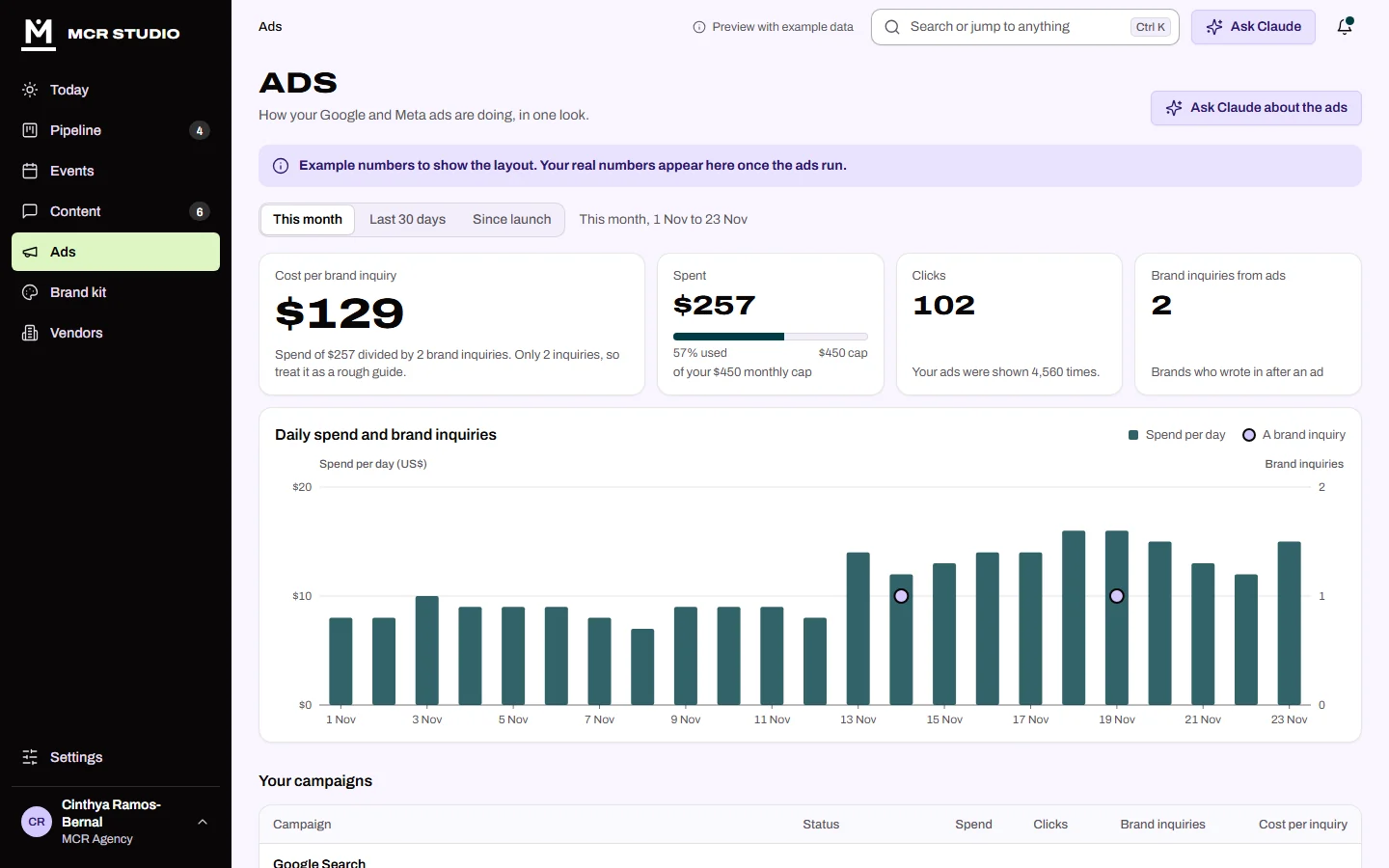
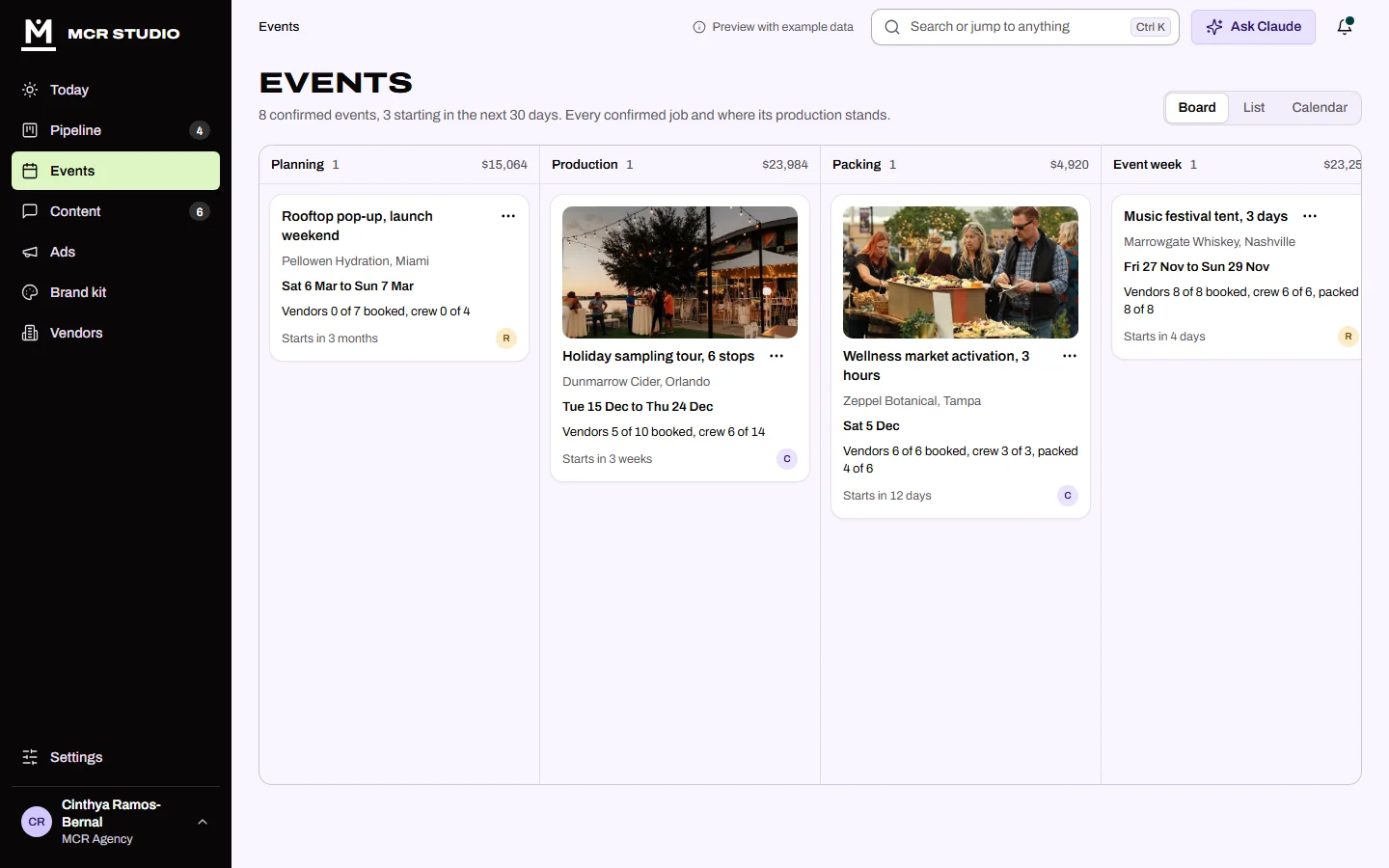
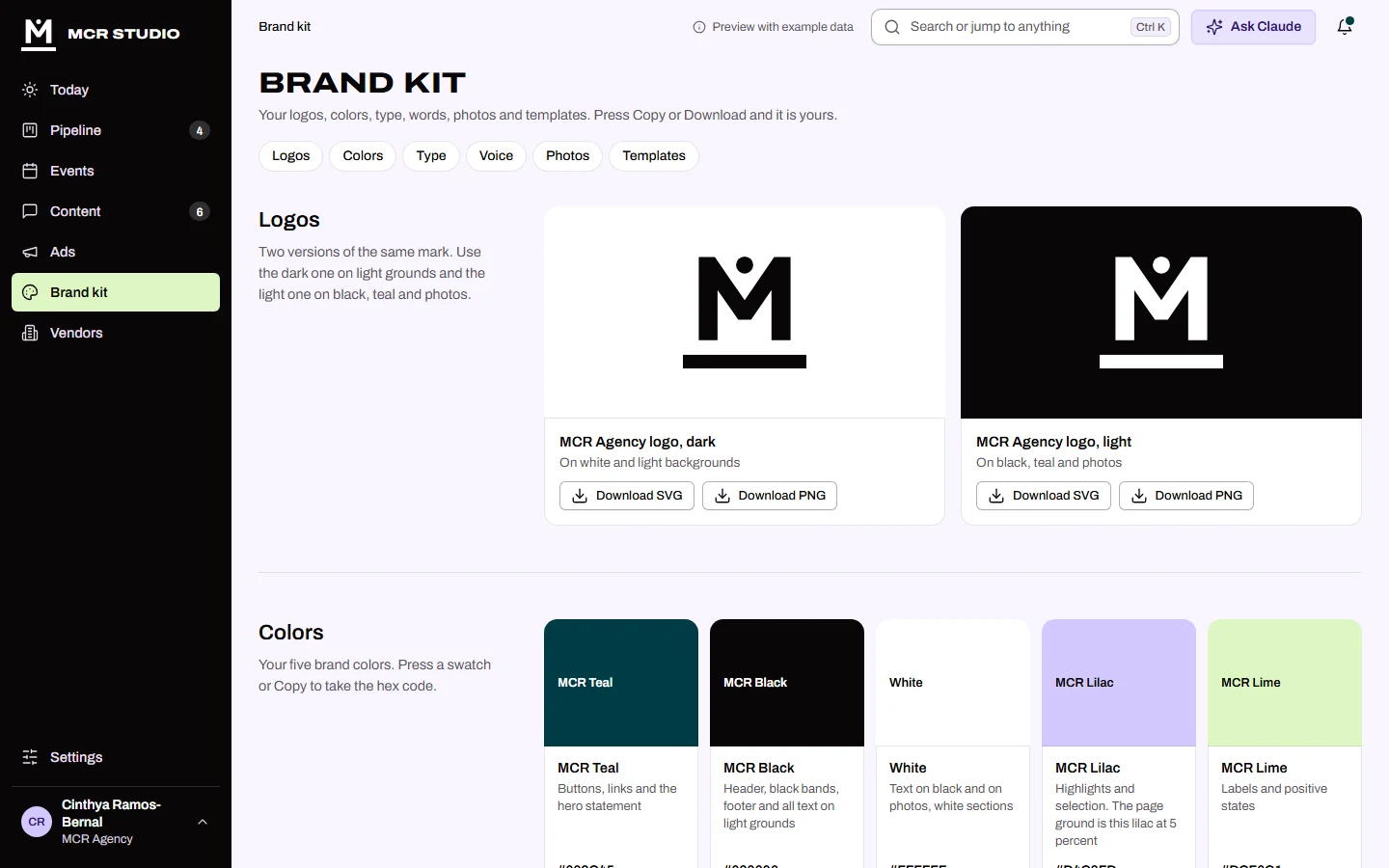
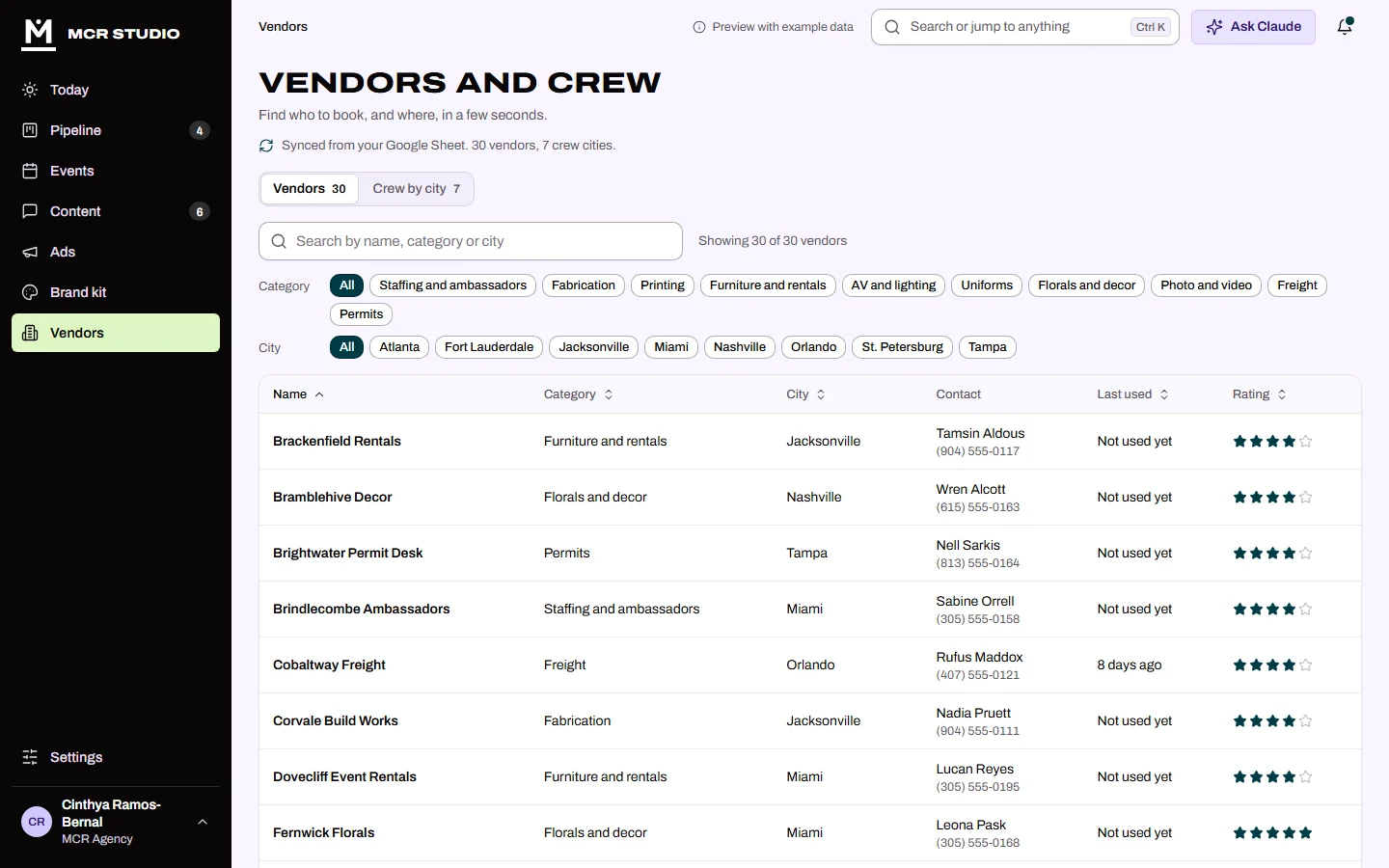
Claude, set up on your MacBook with your brand, your four pillars, your past events and your vendor sheet. A few of the things you can ask it.
“Draft a concept deck for a three-hour sampling activation in Orlando.”
A deck in your colors and type, built around your pillars and your own photos.
“Estimate it by create and direct, make, activate and deliver.”
An estimate from what your past events cost, with the lines to check flagged. You put your mark on it.
“Write next week’s LinkedIn posts from the Suntory ABC Summit recap.”
Drafts in your voice, waiting in MCR Studio for your OK.
“Turn Saturday’s photos into an Instagram carousel.”
A designed carousel from your brand kit, with a caption in your style.
“Write an article on what brands should ask before booking a tasting tour.”
An article for the new site, from the questions your clients ask you.
“Which searches did our ads show up for this month? Anything to change?”
A suggestion with the reason. Nothing changes until you approve it.
Posts, ad changes and estimates all wait for you.
The ads tool refuses any change above the monthly budget you set.
Approve in MCR Studio, then post with one copy and paste.
Your Claude plan, your accounts, your files.
Today your budget buys cheap clicks from ads shown on YouTube, Google Maps and other sites, not only to people searching. Rebuilt, it buys fewer clicks, only from people who searched for an agency, sent to a page made for them.
150clicks a month, about $0.71 each
About 50search clicks a month, about $5.87 each
Your client logos, your five experiences, proof from past events and a short form. A second version is ready to test against it as visits add up.
A small Search campaign aimed at brand teams. Your current campaign is paused, not deleted.
Facebook and Instagram ads shown only to people who already looked at your work, switched on once that audience is big enough.
The Google tag and the Meta pixel count every inquiry. Spending limits sit on both accounts.
Why Meta as a reminder, not a finder: on our call, reaching beverage company owners on Facebook came up. Meta treats job details as a suggestion, so it cannot reliably pick out a brand’s field marketing manager. Shown to people who already visited your work, it is a cheap reminder instead. Click figures: today’s are from your Google Ads screen on our call; the Search figures are industry averages for business services (LocaliQ, June 2026: $5.87 a click, 4.85% of clicks send a form).
Projections for the first year, with the system and without it: the inquiries you can see and count, the time you get back, and what one activation bills. Estimates with their working shown, and room to put in your own numbers.
Running total of form inquiries from the January start. With it, every one from the landing page and the contact form is counted in MCR Studio, with where it came from. Without it, referrals and the odd website inquiry still arrive, but none is counted, so no ad or search can be steered by it. The line with it also spends about $300 a month on Google, against $106 today.
Working: about $300 a month on Google Search at the industry average of $94 to $121 an inquiry gives about 2.5 to 3.2 a month, the top of the band. Searches for an agency like yours in Florida are rare (they barely register on Google Trends), so the lower edge assumes about 1 a month. Week 8 is a fixed check: no brand inquiry by then, pause Search and move the money to outreach.
| End of | With it, about 1 a month | With it, about 3 a month | Without it, counted |
|---|---|---|---|
| March | 3 | 9 | 0 |
| June | 6 | 18 | 0 |
| September | 9 | 27 | 0 |
| December | 12 | 36 | 0 |
Hours a week spent getting next week’s posts ready.
Without: your words on our call, “at least one day”. With: my estimate, since Claude drafts or checks the posts, puts in the photos from your brand kit, and you approve them in MCR Studio.
back every week, about 300 hours a year
From the LinkedIn review alone, before decks and estimates. My estimate.
counted, from the first week of ads
Today none is, so no one can tell which ad, page or search brought a client.
bills more than the whole system costs
At your own $5K example, before your costs.
No monthly fee to me. The ad money goes straight from your card to Google and Meta, and you can stop either of them.
On our call you asked whether the $106 could come down. It goes up instead, because today’s campaign counts nothing and sends every click to the home page. The week 8 check stops Search if no brand has written in, so up to that check the ads cost about $800 in all. Monthly caps hold the ads at these budgets, and the week 8 check gives the spend an end point if it is not working.
What you have in your hands, and when, counting from a start in the first days of December.
Claude on your MacBook, your brand loaded, one training call.
Decks, estimates by your pillars, posts and articles, before your ChatGPT agents change.
Your portal and the landing page handed over, with the Google tag and the Meta pixel on the new site.
My check-ins on day 3, 7 and 14. After that, ask Claude about the ads whenever you like; you approve every change.
Switched on about 30 days after the pixel, if the audience is big enough.
No brand inquiry by then: pause Search and move the money to outreach.
The website contract stays separate and closes first. This contract closes at handover; the check-ins and 30 days of fixes come after it, at no charge.
Four clients, on camera, in their own words.
Watch them at mcr-proposal.agentnest.co
All of it is included. Nothing here is an extra.
$2,888
The three parts and the ads setup, in two milestones, as a new contract. No monthly fee to me.
Your AI workspace, ready before 11 December.
MCR Studio and the landing page, handed over by Friday 18 December.
Google and Meta set up, two weeks of check-ins and 30 days of fixes, at no extra charge.
One activation at your own example, a year of the ads with your own numbers, and what an ads manager would charge for the same year.
Against your own example from our call: “I have another event that could be 5K for an activation.”
Your own example from our call. It is what the job is billed at, before your vendor, crew and freight costs, and on its own it is larger than the whole system’s price.
The line shows work billed from the new brands the ads bring, over the first twelve months and before your own costs, next to what you put in: the $2,888 once plus the ads each month.
On paper the figures are set at 2 brand inquiries a month, 4 in 10 becoming a job, $5,000 a job (your own example) and $450 a month on ads. Change them on the web page at mcr-proposal.agentnest.co.
| Brand inquiries a month | In 12 months | Jobs, 4 in 10, on average | Billed at $5,000, before costs | Put in |
|---|---|---|---|---|
| About 1, searches stay rare | 12 | 4.8 | $24,000 | $8,288 |
| About 2 | 24 | 9.6 | $48,000 | $8,288 |
| About 3, the industry average | 36 | 14.4 | $72,000 | $8,288 |
These are your inputs, not a promise. Without the system, what you have today carries on: your three principal clients, referrals, trade shows, and the website, which brought two clients this past year by your own count. None of that is in the line, in either case: it shows only what the new ads add.
The ad money itself goes from your card to Google and Meta in every case. This is only what you pay for someone, or something, to run it.
This system also includes the workspace, MCR Studio and the landing page, which an ads manager would not. In the first year it costs about a month of an ads manager’s fee.
The charts on this page are estimates to help you decide, with the working shown. I promise what I build. Referrals and your own outreach will still bring most new clients; the ads support them.